
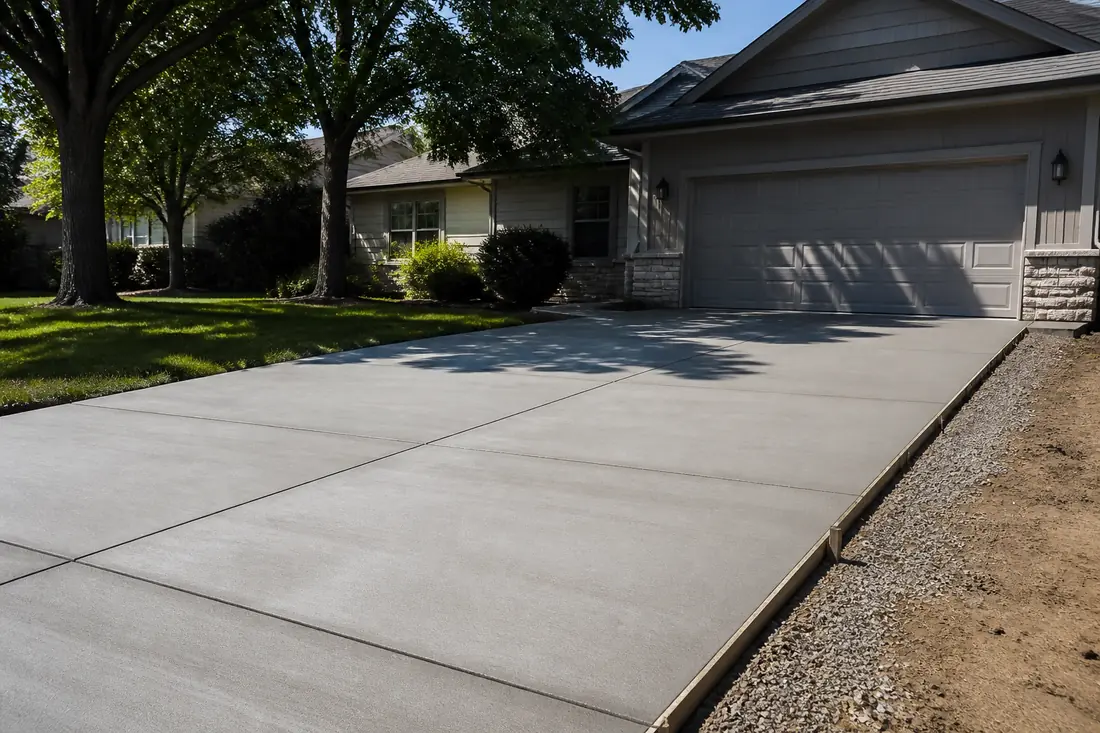
Concrete Driveways in Boise, ID — What to Expect
Your driveway works harder than any other concrete on the property. It carries vehicle loads daily, it takes the full freeze-thaw cycle without the shelter a patio gets from the house, and it is usually the first thing anyone sees. Those three demands pull in different directions, and a driveway that was poured to the thickness of a patio shows it within a few winters.
What decides the outcome is mostly invisible once the pour is done. Base preparation, compaction and drainage do more for slab life than anything in the mix. Much of Boise sits on Boise River alluvium — sand and gravel that carries load well and drains freely. The Bench and the Foothills are different ground, capped with windblown silt that behaves nothing like the gravel below it, so what worked on one side of town is not automatically right on the other.
Reinforcement, joint layout and mix strength then handle the loads and the movement. Control joints are cut so the slab cracks where it was planned to rather than across the middle, thickness is set for what actually parks on it, and the mix is specified with air entrainment — millions of tiny air bubbles that give freezing water somewhere to expand into as it turns to ice. It is an important part of freeze-thaw-resistant concrete, though durability also depends on the mix design, the water-cement ratio, curing, finishing, drainage and how exposed the slab is.
What Is Included
- Base excavated, graded and compacted before any concrete is ordered
- Thickness set for vehicle loads, not a default figure
- Air-entrained mix, so freezing water has somewhere to go
- Control joints cut and placed rather than left to chance
- Reinforcement sized to the slab and the use
- Drainage away from the house and the garage slab
The Concrete Driveways Process
- 1
Step 1: Assess the Existing Surface
Whether the old driveway is coming out, being poured over, or is sound enough to repair. That decision changes the price more than anything else and gets made first.
- 2
Step 2: Excavate and Build the Base
Excavation to depth, graded fall, and compaction in lifts. On outwash gravel this is quick but it is not optional — a slab is only as stable as what is under it.
- 3
Step 3: Form, Reinforce and Set the Joints
Forms set to the finished grade, reinforcement placed and supported off the base rather than pulled up afterwards, and the joint layout marked before the truck arrives.
- 4
Step 4: Pour, Finish and Cure
Poured, levelled off, floated smooth and then broom finished so it grips underfoot. Curing is protected, because concrete that dries rather than cures never reaches the strength it was mixed for.
Types of Concrete Driveways in Boise
New Driveway Installation
A driveway where there was none, including excavation, base, drainage and the apron at the street.
Driveway Replacement
Existing slab broken out and hauled, base corrected, and a new driveway poured to current thickness and reinforcement.
Driveway Extensions and Parking Pads
Widening for a third vehicle, an RV pad, or a turnaround, tied into the existing slab with a proper joint.
Aprons and Approaches
The section between the driveway and the street, where the jurisdiction usually has its own requirements.
What Matters When Choosing a Driveways and Patios Contractor in Boise, ID
The base is inspected before anything is poured
Most slab failure in this climate starts underneath. Compaction, drainage and frost depth get checked and recorded before concrete is ordered.
Mix and thickness matched to the load
A driveway carrying vehicles and a garden path do not take the same slab. Thickness, mix strength and reinforcement are specified for the actual use.
Straight answers on repair versus replacement
Some slabs are worth lifting or resurfacing and some are past it. Which one yours is gets said plainly, before a price is attached to either.
Concrete Driveways FAQs
How thick should a concrete driveway be?
It depends on what parks on it. A standard passenger-vehicle driveway is commonly four inches over a prepared base, and anything carrying an RV, a boat trailer or delivery vehicles is normally thicker with heavier reinforcement. Thickness gets set from the actual use rather than a default, because a slab poured too thin cracks under loads it was never sized for.
Why does concrete crack, and can it be avoided?
Concrete shrinks as it cures and moves with temperature, so it will crack. What good work controls is where. Control joints are cut at planned spacing so the slab relieves that stress along a straight line instead of across the middle. A driveway with no joints, or joints cut too late or too shallow, cracks wherever it likes.
Can a new driveway be poured over the old one?
Sometimes, and it is worth asking about because it saves demolition and haulage. It works where the existing slab is sound, drainage still works and the extra height does not create a problem at the garage door or the street. Where the old slab is moving or the base under it has failed, pouring over it inherits the problem.
Does concrete in Boise need air entrainment?
For exterior concrete in this climate it is an important part of the specification. Air entrainment puts millions of microscopic bubbles through the mix, and those give water somewhere to expand into when it freezes instead of forcing the surface apart. It matters more on anything that gets de-icing salt, because salt increases the number of freeze-thaw cycles the surface goes through. It is not a guarantee on its own — mix design, water-cement ratio, curing, finishing and drainage all bear on how well concrete holds up.
What is the difference between control joints and expansion joints?
They solve opposite problems. Control joints are cut or tooled into the slab to give shrinkage cracking a straight line to follow, so the slab cracks where it was planned to rather than across the middle. Expansion or isolation joints are gaps that let two separate elements move independently — a driveway against a garage slab, or a patio against the house foundation. A slab can be well jointed for shrinkage and still transmit movement into a building if the isolation joints were left out.
How long before we can drive on it?
Foot traffic is usually a day or so and vehicles considerably longer, because concrete gains most of its strength over the first weeks rather than the first days. Exact timing depends on the mix, the thickness and the weather during curing, so it is given for your specific pour rather than as a general rule.
Other Services in Boise
- Concrete Repair and ResurfacingFlaking, pitted and worn-out surfaces repaired or resurfaced, where the slab underneath is still solid.
- Concrete Leveling and Slab LiftingSunken driveways, walks and patios lifted back to level without breaking them out.
- Concrete FoundationsFoundations for new builds, additions, garages and shops — excavation, footings, walls and slab.