
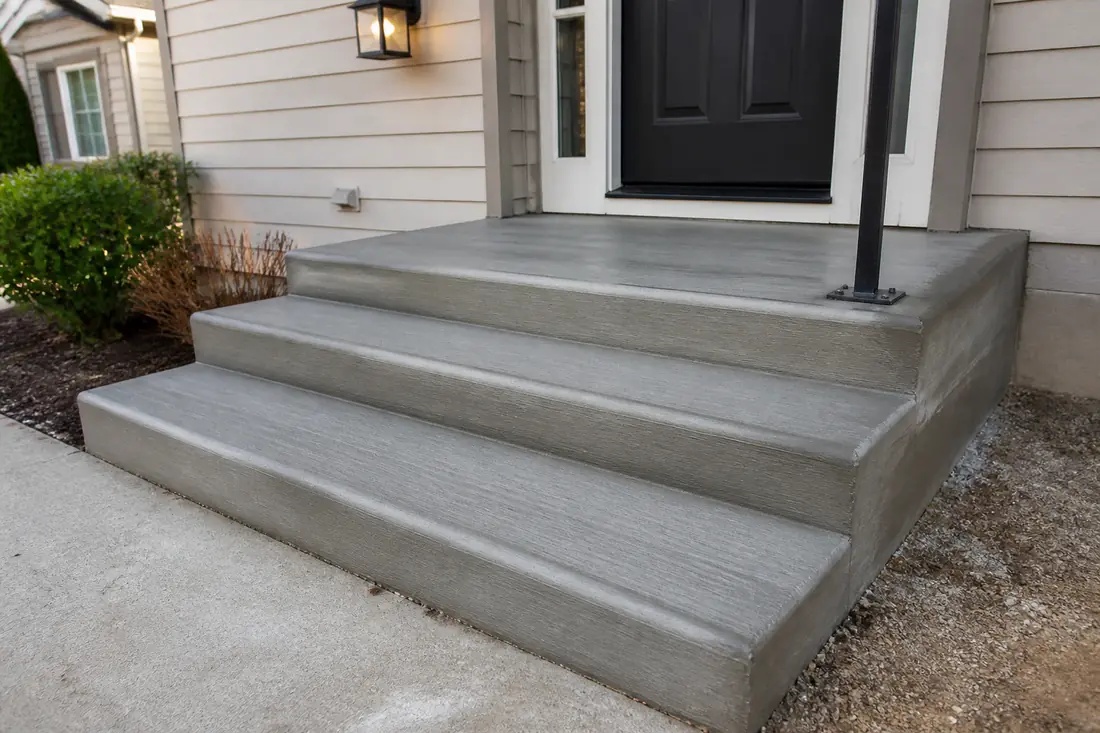
Concrete Steps and Stairs in Boise, ID — What to Expect
Steps are the one place where getting the measurements exactly right is a safety matter, not just a quality one. People climb stairs on autopilot, and a single riser that differs from the ones below it is the classic trip. Rise and run are set once and repeated exactly, which sounds obvious and is the most common thing found wrong on failed exterior stairs.
The second issue is frost. Exterior steps at an entrance sit exactly where roof runoff and snowmelt concentrate, and a stair built on a shallow base in that position will heave. That is why steps pull away from the house, tilt, or open a gap at the stoop — the ground under them moved and the structure did not. Footings taken below frost depth and drainage that moves water away from the base are what prevent it.
Then there is the junction with the house. A stair or stoop poured tight against the foundation and bonded to it transmits its own movement straight into the building. An isolation joint at that face keeps the two independent, which is a small detail with a large consequence when the ground freezes.
What Is Included
- Rise and run set once and repeated exactly
- Footings taken below frost depth on entrance stairs
- Isolation joint where the stair meets the foundation
- Broom or textured finish on treads for wet-weather grip
- Drainage routed away from the base rather than into it
- Handrail anchor provision set during the pour where required
The Concrete Steps and Stairs Process
- 1
Step 1: Set the Geometry
Total height divided into equal risers, run set for comfortable footing, and the landing sized to suit the door swing. This is settled before anything is dug.
- 2
Step 2: Dig Footings to Frost Depth
Entrance stairs sit where water concentrates, so the footing goes below frost rather than on the surface. This is the single detail that decides whether the stair stays where it was built.
- 3
Step 3: Form, Isolate and Reinforce
Forms built to the set geometry, an isolation joint at the house face, and reinforcement through the treads and the landing.
- 4
Step 4: Pour, Finish and Detail the Edges
Placed and finished with a textured tread surface for grip, edges tooled, and handrail anchors set while the concrete is still plastic.
Types of Concrete Steps and Stairs in Boise
Front Entry Steps and Stoops
The most common flight on a Boise home, sized so the landing suits the door swing.
Basement and Side Entrance Stairs
Below-grade entries, where drainage at the base of the stair matters as much as the stair itself.
Step Replacement
Failed, tilted or separating steps removed, the cause corrected, and a new flight built on proper footings.
Landings and Platforms
Intermediate and top landings sized for door clearance and safe footing.
What Matters When Choosing a Driveways and Patios Contractor in Boise, ID
The base is inspected before anything is poured
Most slab failure in this climate starts underneath. Compaction, drainage and frost depth get checked and recorded before concrete is ordered.
Mix and thickness matched to the load
A driveway carrying vehicles and a garden path do not take the same slab. Thickness, mix strength and reinforcement are specified for the actual use.
Straight answers on repair versus replacement
Some slabs are worth lifting or resurfacing and some are past it. Which one yours is gets said plainly, before a price is attached to either.
Concrete Steps and Stairs FAQs
Why are my front steps pulling away from the house?
Almost always because the steps are moving and the house is not. If the stair was built on a shallow base rather than a footing below frost depth, seasonal freezing lifts and drops it, and the gap at the house opens a little more each year. Rebuilding on a proper footing is the fix; filling the gap is not.
Can cracked concrete steps be repaired?
It depends whether the crack is the problem or the symptom. Surface damage on a stair that is still sitting where it was built can often be repaired or resurfaced. A stair that has tilted, separated or dropped has a foundation problem underneath it, and patching the visible damage leaves that untouched.
Do the steps all have to be the same height?
Yes, and it is the detail worth insisting on. People climb stairs without looking, so a riser that differs from its neighbors is the standard cause of a fall. Codes put tight limits on the variation allowed between risers in a flight for exactly that reason.
Do I need a handrail?
Once a flight reaches a certain number of risers, generally yes, and the requirement comes from the building code rather than preference. Anchor provision is easiest set during the pour, so whether a rail is going on gets decided before the concrete arrives rather than drilled in later.
Other Services in Boise
- Concrete Repair and ResurfacingFlaking, pitted and worn-out surfaces repaired or resurfaced, where the slab underneath is still solid.
- Concrete Leveling and Slab LiftingSunken driveways, walks and patios lifted back to level without breaking them out.
- Poured Foundation WallsCast-in-place basement, crawl space and stem walls, formed and reinforced to carry soil and building load.