
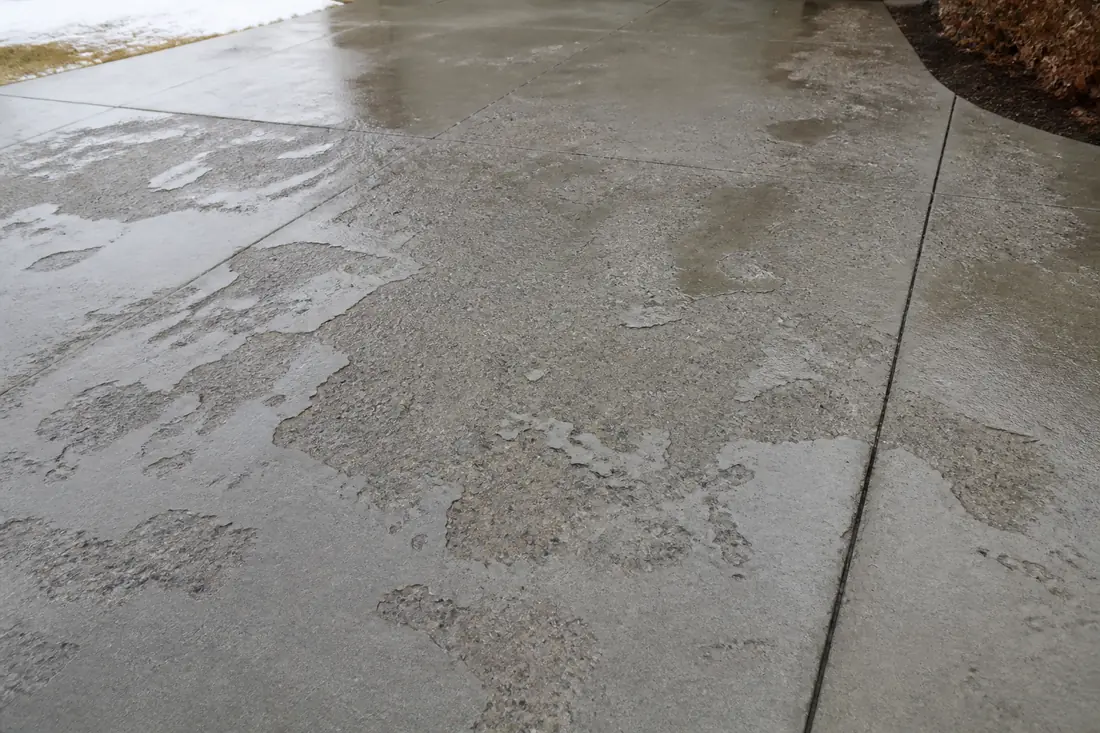
Three winters after the pour, the driveway starts shedding. Not cracking — the top skin comes away in thin flakes and leaves sand and stone showing, usually worst along the apron and around the steps.
The slab underneath is generally fine. What failed is the outermost few millimeters, and what decided whether it would fail was settled before the truck arrived on site.
Concrete in a freezing climate is protected by microscopic air bubbles deliberately mixed into it. There is a number for that on the delivery ticket. The awkward part is that the number on the ticket is not quite the property that does the protecting — and the test that measures the property that matters takes days to come back.
Last reviewed: 3 September 2026 against FHWA Tech Brief FHWA-HIF-17-009, Air Entrainment and Concrete Durability, and the ACI exposure classes reproduced in it.
Why water in concrete is a problem
Concrete is porous at several scales at once. Gel pores measured in nanometers, capillary pores left where mixing water was, and — if somebody put them there — much larger spherical air voids between roughly 0.05 and 1.25 mm.
Freezing water expands. In a confined pore, that expansion generates pressure in the paste around it.
What determines whether that pressure does damage is how saturated the concrete is. FHWA puts the threshold plainly: damage occurs when concrete freezes in a critically saturated state, somewhere between 75 and 91 percent saturation, with recent research pointing at around 86 percent. Below that, the freeze is survivable. Above it, damage can occur in a single cycle.
What the bubbles are actually for
The entrained voids are not there to make the concrete lighter or more workable. They are there to stay empty.
Because they are comparatively large, they are the last spaces in the concrete to fill with water. Gel and capillary pores saturate quickly; entrained voids remain largely unsaturated under normal service. So when the small pores freeze and need somewhere to push, there is empty space adjacent to receive it.
That is the whole mechanism. Air entrainment works by keeping the overall degree of saturation below the critical level, and by giving pressure a short path to somewhere it can go.
Which sets up the distinction that matters.
Total air is not spacing
Two mixes can carry identical air content and behave differently, because what protects the paste is not how much air is present but how far any point in the paste sits from the nearest void.
The measure for that is the spacing factor, and FHWA gives the target:
Spacing factor — An index related to the distance of one air void to the next and recommended to be 0.008 inches (0.200 mm) or less.
Alongside it, specific surface of 600 in²/in³ or greater.
Here is the practical problem. Spacing factor is determined by ASTM C457 — microscopic examination of a polished slice of hardened concrete. It needs a trained technologist, takes around three hours to run, and results take days. FHWA is direct about the consequence: C457 is suited to mixture design and forensic investigation, but not to quality control or acceptance testing during construction.
So the tests actually run on site — pressure meter, volumetric, gravimetric — measure total air, which is a proxy. A good one, usually. Not the thing itself.
What to specify for a Treasure Valley driveway
ACI sorts freeze-thaw exposure into classes, and the distinction that matters to a residential slab is between F2 and F3:
  F1   moderate     freezing, low probability of near-saturation
  F2   severe       freezing, likely near-saturated, NO deicing chemicals
  F3   very severe  freezing AND deicing chemicals
A driveway that gets salted, or that receives salty slush dripping off a car, is F3. Not F2. That distinction is decided by how the surface is used, not by where it sits.
Required air content then depends on aggregate size, because smaller aggregate means more paste to protect:
  nominal max aggregate      F1        F2 / F3
  ────────────────────────────────────────────
  3/8 in                     7.0 %     7.5 %
  1/2 in                     7.0 %     7.0 %
  3/4 in                     6.5 %     7.0 %
  1   in                     6.5 %     6.5 %
  1-1/2 in                   6.0 %     6.5 %

  field tolerance: ±1.5 %
Two footnotes worth knowing. Rounded aggregate can allow roughly 1 percent less air than the table shows, since ACI’s proportions assume angular coarse aggregate. And pavements taking heavy deicer use may need more than the table, not less.
The Treasure Valley is a genuine freeze-thaw environment for this purpose — not because winters here are severe, but because the surface crosses freezing repeatedly while wet, which is the condition that accumulates damage.
Where a good mix still fails
Specification is necessary and not sufficient. Three things undo it after the truck arrives.
Water added on site. Adding water at the chute to improve workability raises the water-cementitious ratio, which increases capillary porosity and lets the concrete reach critical saturation faster. It also tends to reduce air content.
Finishing while bleed water is present. Working that water back into the surface produces a top layer with a higher water content — weaker and more absorbent than the concrete beneath it. That layer is precisely the one that later comes off.
Over-troweling exterior flatwork. Excessive troweling densifies and closes the surface, which can disturb the air-void system in the top few millimeters, exactly where it is needed. It is why a driveway and an interior floor are finished differently.
Four questions before a pour
None of these are unreasonable and all have specific answers:
- What exposure class is this slab being proportioned for? For a salted driveway the answer should be F3.
- What air content, and at what nominal maximum aggregate size? Both numbers, together — one without the other means nothing.
- Will air be measured at delivery? A pressure meter test takes minutes.
- What happens if water is added on site, and will air be re-checked if it is?
If it is already scaling
Scaling confined to the top eighth of an inch over limited areas is a surface durability problem, not a structural one, and the slab beneath is frequently sound. Whether resurfacing, a protective treatment, or replacement is right depends on depth, extent and the condition underneath — a site assessment rather than something settled from a photograph.
What is worth knowing before spending anything: sealing does not reverse scaling. A sealer reduces water and salt ingress on sound concrete, which is preventive and genuinely useful. Applied over a surface that is already delaminating, it does not restore what has gone.
The cheapest intervention available is also the least technical. Through the first winter especially, keep deicers off new concrete and clear snow mechanically. Sand gives traction without adding the chemistry that drives saturation up.
Sources
- FHWA — Tech Brief: Air Entrainment and Concrete Durability (FHWA-HIF-17-009, November 2019) — source of the critical saturation range, the spacing factor and specific surface targets, the ACI exposure classes and the air content table
- ASTM C457 — Microscopical Determination of Parameters of the Air-Void System in Hardened Concrete
- ASTM C672 — Scaling Resistance of Concrete Surfaces Exposed to Deicing Chemicals